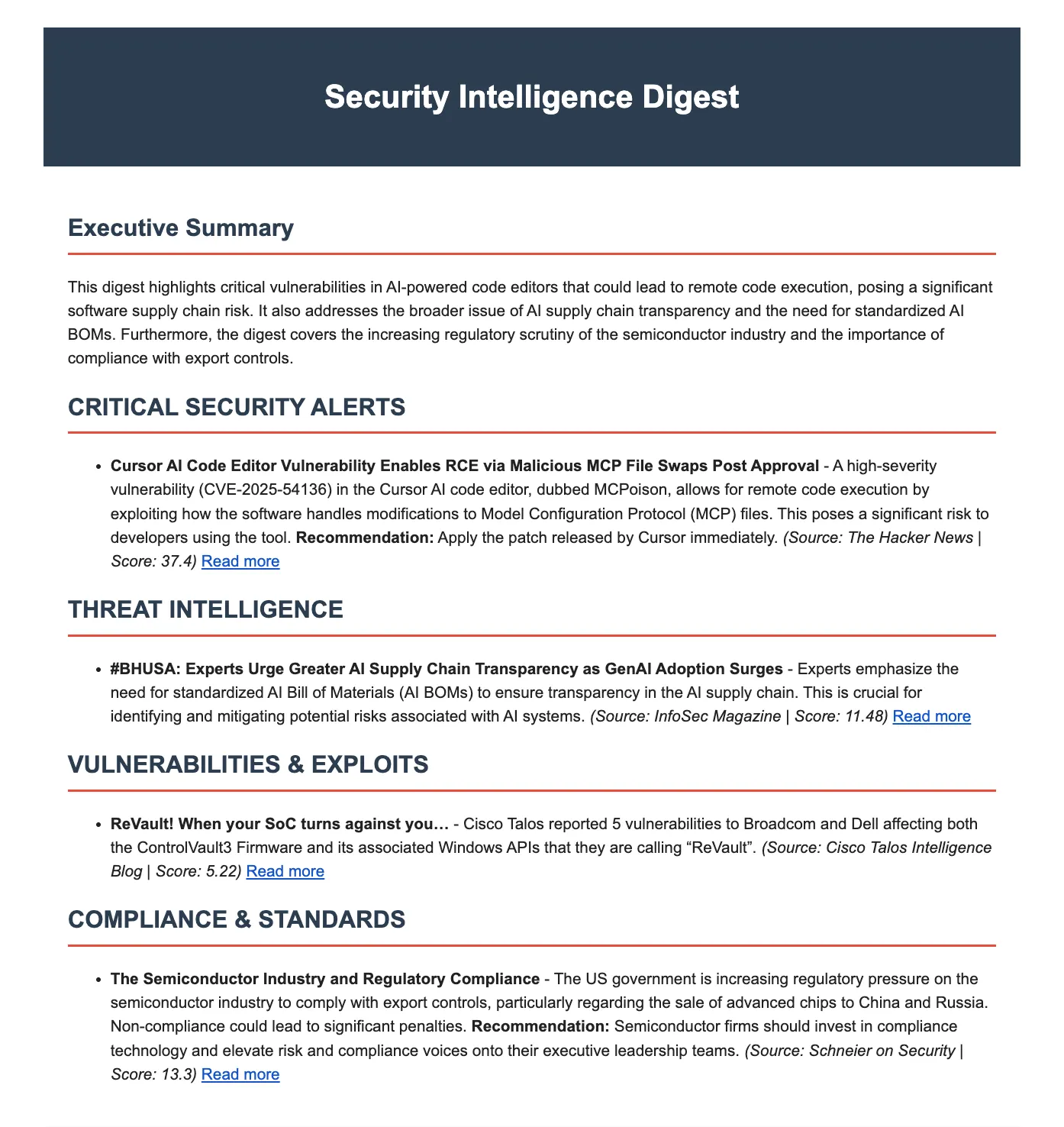
I found Niranjan G’s security digest workflow and saw room to make it better. His three-category approach was solid. It left room for deeper insights and more tailored recommendations.
What the original workflow did
Niranjan’s original workflow was solid. It handled three tracks (Security, Privacy, Compliance), filtered content to the last 24 hours, and delivered clean HTML digests via email.
Prioritizing signal over volume
Not all security news is created equal. Getting 47 articles about the same vulnerability doesn’t make me more secure. It makes me want to close my laptop and go for a walk. Security teams need better information, intelligently prioritized and contextually relevant.
I rebuilt the workflow around three principles:
- Quality. Extra sources, but with reliability scoring.
- Context-Aware Prioritization. Threats affecting our actual tech stack take precedence.
- Actionable Intelligence. Summaries help. Actionable insights matter more.
Scoring each source by reliability
Niranjan’s original used basic RSS feeds across three categories. My version gives each source detailed intelligence metadata:
{
  "name": "CISA Advisory Alerts",
  "rss_url": "https://www.cisa.gov/cybersecurity-advisories/alerts.xml",
  "priority": "critical",
  "weight": 10,
  "reliability": 0.95,
  "category": "government"
}
This is operational intelligence. When CISA publishes an alert, it automatically gets higher priority than a vendor blog post. The system weighs source credibility, not just content recency.
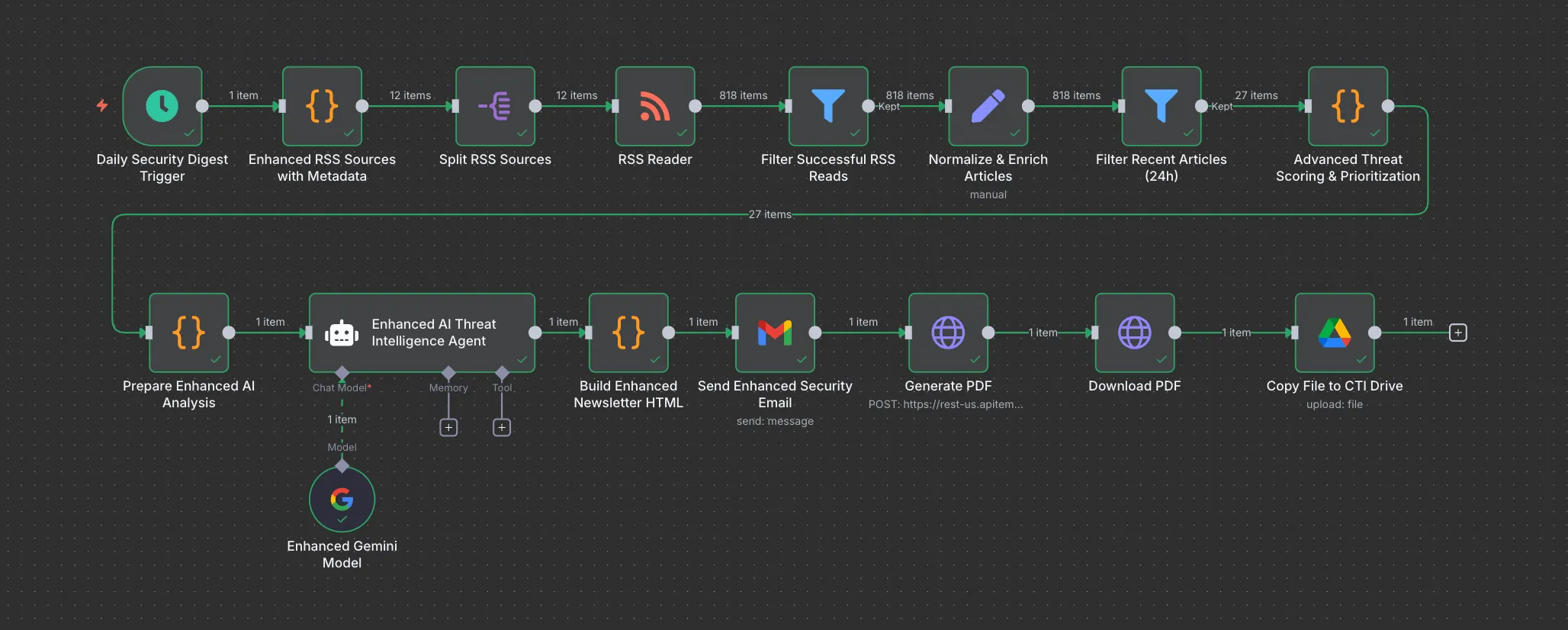
I also consolidated three separate category workflows into one unified intelligence pipeline. Instead of separate Security/Privacy/Compliance emails, you get one briefing organised by threat priority.
Scoring each article by threat severity
The original workflow treated all articles equally. A critical zero-day got the same treatment as a vendor blog about password hygiene. My version implements dynamic threat scoring.
// Calculate threat severity and relevance scores
const scoredArticles = items.map(article => {
  const title = (article.title || '').toLowerCase();
  const content = (article.content || '').toLowerCase();
  const summary = (article.contentSnippet || content).toLowerCase();

  let threatScore = 0;
  let relevanceScore = 0;
  let severityLevel = 'low';
  let techRelevance = [];

  // Calculate threat severity
  Object.entries(threatKeywords).forEach(([level, keywords]) => {
    Object.entries(keywords).forEach(([keyword, score]) => {
      if (content.includes(keyword) || title.includes(keyword)) {
        threatScore += score;
        if (score >= 7) severityLevel = 'critical';
        else if (score >= 4) severityLevel = 'high';
        else if (score >= 2) severityLevel = 'medium';
      }
    });
  });

  // Calculate tech stack relevance (whole word, in title or summary)
  Object.entries(techStack).forEach(([tech, score]) => {
    if (containsWholeWord(title, tech) || containsWholeWord(summary, tech)) {
      relevanceScore += score;
      techRelevance.push(tech);
    }
  });
The automation uses weighted keyword analysis to score threats. Terms like “zero-day exploits” and “ransomware” get higher priority than general advisories. The system tracks our specific environment and applies priority multipliers, so threats affecting our actual infrastructure outweigh theoretical attacks.
The final calculation:
  // Apply source reliability weighting
  const finalScore = (threatScore + relevanceScore) * article.source_reliability;

  // Only include if at least one tech stack keyword is in the title or summary
  const isRelevant = techRelevance.length > 0;

  return {
    ...article,
    threat_score: threatScore,
    relevance_score: relevanceScore,
    final_score: Math.round(finalScore * 100) / 100,
    severity_level: severityLevel,
    is_critical: severityLevel === 'critical' || finalScore >= 15,
    tech_relevance: techRelevance,
    is_relevant: isRelevant
  };
});

// Filter for relevance and sort by final score descending
const relevantArticles = scoredArticles.filter(article => article.is_relevant);
const sortedArticles = relevantArticles.sort((a, b) => b.final_score - a.final_score);

return sortedArticles.map(article => ({ json: article }));
This limits analysis to the most pressing threats, prioritising immediate relevance over historical context.
Enhancement #3: AI Analysis
The AI node has detailed instructions to analyse threats through a structured intelligence framework:
- Attack technique identification using industry-standard methodologies (e.g., MITRE ATT&CK)
- Business impact assessment beyond technical severity
- Actionable mitigation recommendations tailored to threat types
- Executive-ready summaries for leadership communication
This replaces generic summaries with structured threat intelligence analysis.
Archiving each briefing as a PDF
The original delivered HTML emails. My version adds:
- PDF Archive Generation. Formatted reports for documentation and offline access.
- Google Drive Node. Organised storage and team sharing.
The workflow generates a PDF version of each briefing and archives it to Google Drive with proper naming conventions for easy retrieval.
What changes day to day
These enhancements change daily security operations.
Original approach: Three separate emails with categorised security news summaries. Useful, but you still manually assess priority and relevance.
Enhanced version: One prioritised intelligence briefing that immediately identifies:
- Critical vulnerabilities affecting your specific infrastructure
- Threat campaigns targeting your industry with relevant defensive measures
- Which “critical” advisories actually don’t affect your systems
You receive actionable intelligence instead of consuming raw information.
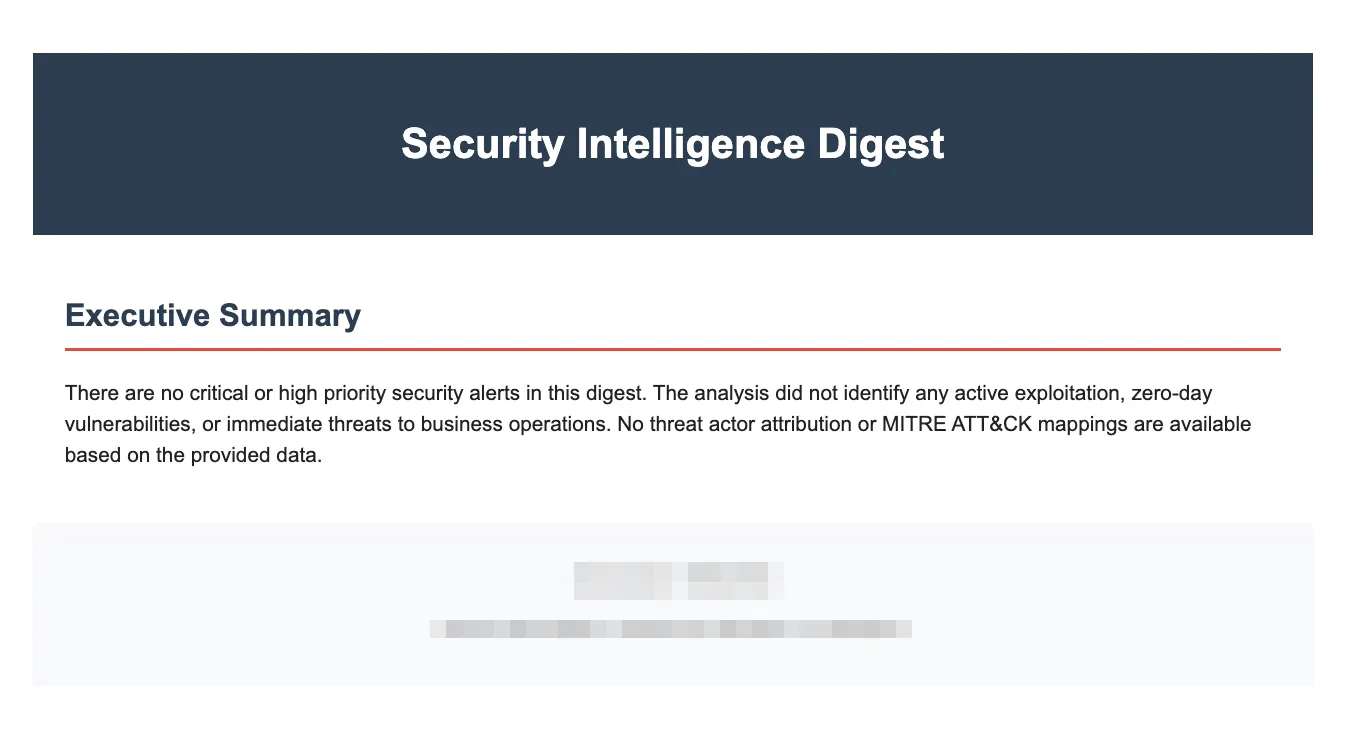
Example of in-scope intelligence output from the workflow.
Implementation Notes
The complete workflow includes:
- 12 intelligence-grade sources with reliability scoring
- Dynamic threat assessment based on 50+ security keywords
- Technology stack awareness for 15+ platforms and tools
- Automated archival and distribution
The Bottom Line
Effective security automation improves decision-making, not just speed. Integrating threat intelligence principles into the content curation process turned a traditional newsletter into a comprehensive intelligence briefing.